Table of Contents
- The Verdict: When Epoxy Garage Flooring Is Worth It
- Durability, Longevity and Failure Analysis: Why Some Epoxy Floors Fail
- Epoxy Garage Floor Cost Per Square Metre: What Actually Drives the Price
- DIY Epoxy vs Professional Installation: Where Each One Wins
- Epoxy Flooring Maintenance Tips and Chemical Resistance
- Climate, Environmental Impact and Resale Value
- Conclusion: Deciding If Epoxy Garage Flooring Is Worth It for Your Space
- Frequently Asked Questions
Last Updated: September 30, 2026
The Verdict: When Epoxy Garage Flooring Is Worth It
For most garages with sound, dry concrete, epoxy garage flooring is worth it: it resists hot tyre pickup, chemical spills and abrasion far better than bare concrete or paint, and it lasts years when the slab is properly prepared. It is not worth it when moisture, contamination or a rushed DIY kit undermines adhesion.
That is the short answer. The longer answer depends on your slab, your budget and how hard you plan to use the space.
Epoxy is worth it when the concrete substrate is dry, clean and mechanically prepared. It is rarely worth it when moisture vapor transmission or surface contamination goes unaddressed.
Durability, Longevity and Failure Analysis: Why Some Epoxy Floors Fail
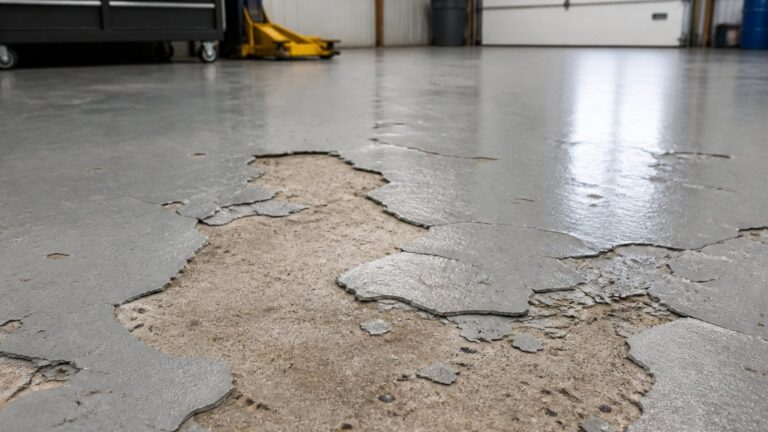
Epoxy fails for three reasons, almost always in combination: moisture vapor transmission through the slab, inadequate surface preparation, and application in the wrong temperature or humidity. Get those right and a quality system can hold up for many years.
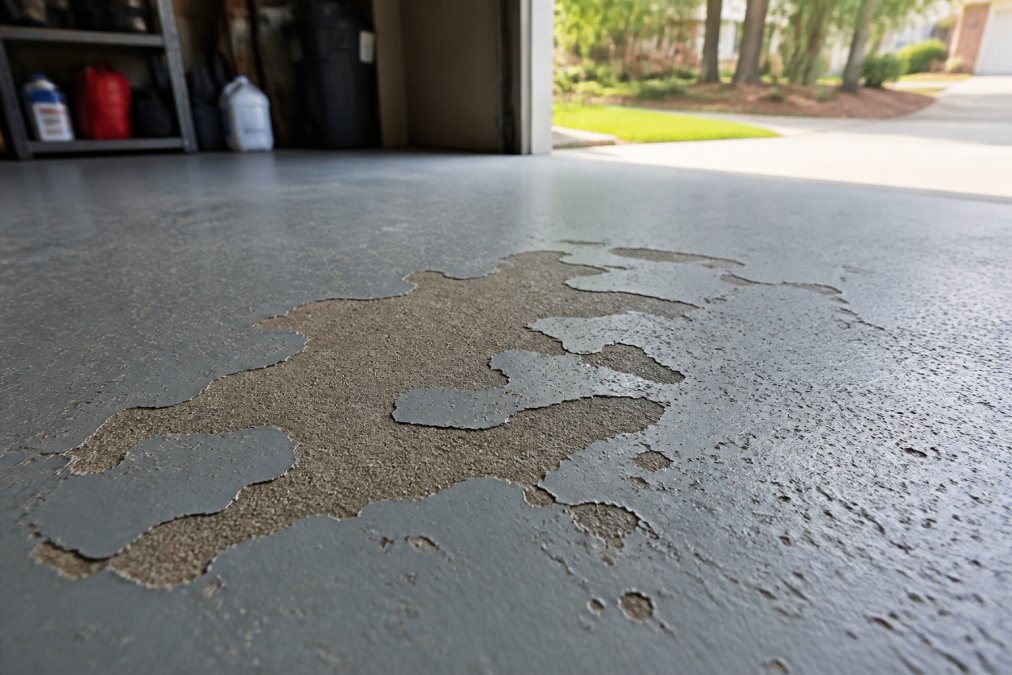
Skipping a moisture test is the most expensive shortcut in this trade. If vapour pressure is high, even premium coatings will bubble and peel, and you will pay twice: once for the failed floor and again to remove it.
Epoxy Garage Floor Cost Per Square Metre: What Actually Drives the Price
Epoxy garage floor cost per square metre varies widely depending on slab condition, system thickness and whether you grind or etch. There is no single national figure, and any quote given without a site inspection should be treated with suspicion. What follows is how to read a quote, not a price list.
The four system tiers you will be quoted
- Thin-film roll-on (DIY kit equivalent). One or two coats over an acid-etched slab. Cheapest per square metre, thinnest mil build, shortest service life. Fine for a lightly used single garage.
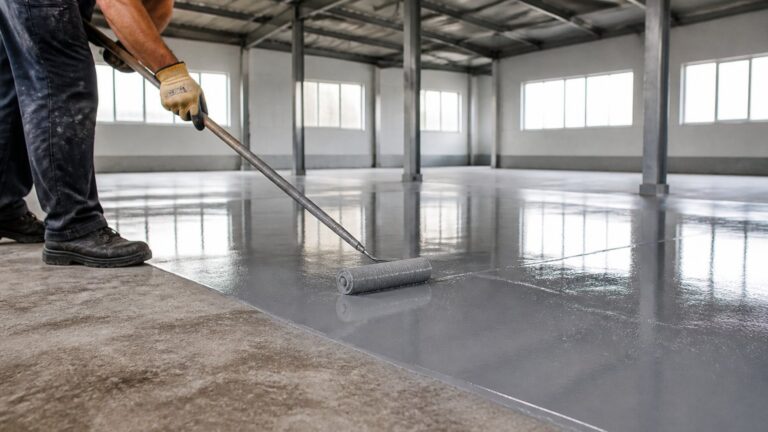
- Standard flake system. Grind, primer, base coat, full flake broadcast, one clear topcoat. The default residential specification and the tier most homeowners actually want.
- High-build flake with urethane topcoat. Same as above but with a thicker base and a UV-stable urethane clear. The right call for hot-tyre parking, jacks and daily traffic.
- Polyaspartic or full broadcast with moisture barrier. The premium tier: fast-cure topcoat, moisture vapour barrier primer where testing demands it, and the longest warranty. Common in workshops and commercial bays.
What actually moves the number
- Surface preparation method. Mechanical grinding costs more than acid etching but delivers far better adhesion. Diamond grinding also removes old coatings, which etching cannot.
- Moisture mitigation. Slabs with high vapour transmission need an epoxy or urethane moisture barrier primer, which adds a material and a labour step. This is the single biggest variable between two quotes for the same floor area.
- System build. A single base coat is cheaper than a primer, base coat, flake broadcast and urethane topcoat. Each additional layer adds material, drying time and labour.
- Area and access. Larger floors cost less per square metre because setup and mobilisation are spread across more area. Tight, obstructed or multi-level spaces cost more.
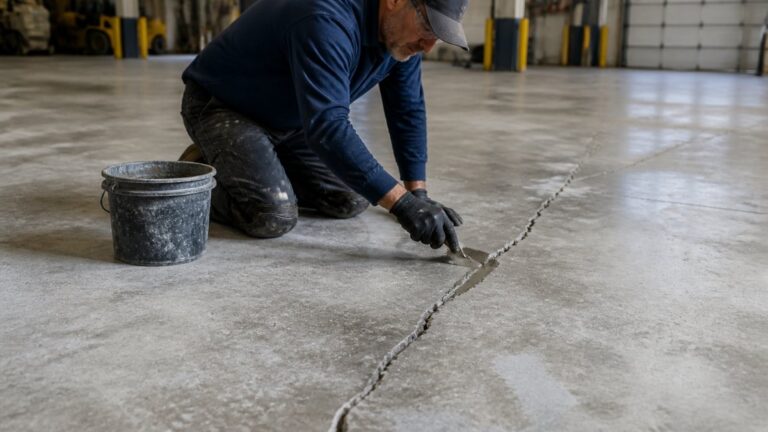
- Repairs. Cracked, spalled or oil-soaked concrete needs patching, crack stitching or grinding back to sound substrate before any coating goes down.
- Coating removal. If there is an existing failed epoxy or sealer, it must be ground off. This is often the line item homeowners did not budget for.
| Cost Driver | Cheaper Option | Premium Option | Effect on Longevity |
|---|---|---|---|
| Preparation | Acid etch | Mechanical diamond grinding | Grinding adheres far better and removes contaminants |
| Moisture control | None | Epoxy or urethane barrier primer | Prevents delamination from vapour pressure |
| Base coat | Thin single coat | High-build multi-coat | Thicker film resists abrasion and hot tyres |
| Topcoat | None | Urethane or polyaspartic | Adds UV and chemical resistance |
| Flake broadcast | Skip | Full broadcast | Improves slip resistance and hides substrate flaws |
| Existing coating | Coat over | Full removal by grinding | Coating over a failing floor guarantees the new one fails too |
How to compare two quotes fairly
If a quote is dramatically lower than the others, the saving is almost always in preparation. That is the one part of the job you cannot see once the floor is coated, and the one part that determines whether the coating lasts five years or fifteen.
DIY Epoxy vs Professional Installation: Where Each One Wins
DIY epoxy kits win on upfront cost for small, dry, well-prepped slabs. Professional application wins on durability, warranty and finish quality, and it is the only sensible route for workshops, warehouses and commercial kitchens. The interesting question is not which is cheaper, it is why DIY jobs fail at the rate they do, and whether your slab is one of the ones that can get away with it.
Why DIY epoxy kits fail, the mechanics
- Acid etching does not open the concrete the way grinding does. Etching dissolves the surface paste and leaves a profile, but it cannot remove oil, grease, old sealer or tyre rubber. On a garage slab that has held a car for a decade, the contamination is exactly where the coating needs to bond.
- Kits are thin. A typical roll-on kit lays down a fraction of the film thickness of a professional high-build system. Thin films have less resistance to abrasion, hot-tyre pickup and impact, so they wear through at the traffic lanes first.
- No moisture test. Most DIY kits do not include a moisture test, and most homeowners do not perform one. If the slab has high vapour transmission, the coating lifts from below regardless of how well it was applied.
- Curing is temperature- and humidity-sensitive. Epoxy needs a stable window to cure. Applying it in cold weather or high humidity stops the chemical reaction and leaves a soft, chalky finish that scratches easily. A garage in a cold snap is not a controlled curing environment.
- Pot life and mixing errors. Two-part epoxy has a working time after mixing. Mix it wrong, or leave it too long, and the coating will not cure properly, a failure mode that does not show up until weeks later.
Where DIY genuinely makes sense
What a professional crew actually brings
- Diamond grinding equipment that profiles the slab and removes contamination in one pass
- Moisture testing before any material is ordered
- The correct primer for the slab, including moisture barrier primers where testing demands them
- Control over curing time, temperature and humidity
- A warranty that means something, because the installer is accountable for the preparation
The real cost comparison
If you are going DIY, spend your budget on preparation, not on a fancier topcoat. A cheap coating on a perfectly ground slab will outlast an expensive coating on a dirty one. Hire the grinder, do the moisture test, and treat the prep as the job, the coating is just the last step.
The most common DIY failure pattern is a coating applied over a slab that was etched but not ground, in a garage that had oil staining. The coating looks fine for a season, then lifts in sheets at the traffic lanes. By then the slab needs full grinding to fix it.
Epoxy Flooring Maintenance Tips and Chemical Resistance
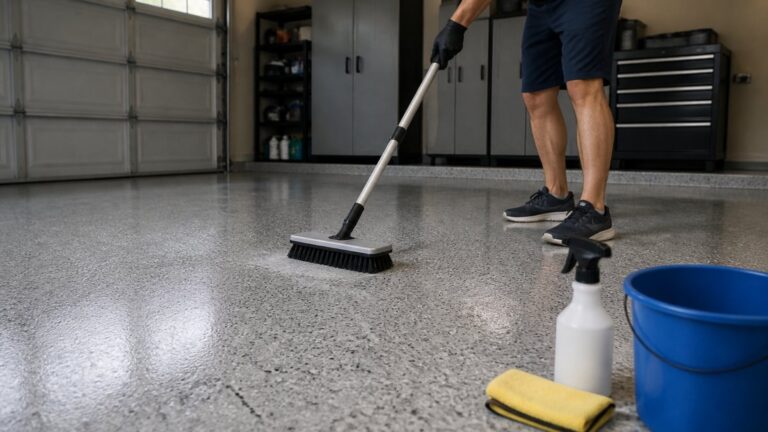
Epoxy flooring maintenance tips come down to three habits: sweep regularly, clean spills quickly, and avoid harsh acids on the surface. A well-cured epoxy floor is one of the easiest surfaces in a building to keep clean.
A simple maintenance schedule:
- Sweep or dust-mop weekly to remove grit that abrades the finish
- Wipe oil and coolant spills promptly with a mild detergent
- Mop with pH-neutral cleaner monthly
- Reapply a topcoat every few years in high-traffic zones
- Inspect edges and joints for lifting after winter
Climate, Environmental Impact and Resale Value
Climate and resale value are two factors most guides ignore, and both matter. In humid coastal conditions and areas with high seasonal rainfall, moisture vapour transmission is a bigger risk, so slab testing and moisture barriers become more important. In colder regions, thermal movement stresses the coating at joints and edges.
Climate drives the technical spec, not just the colour. Humid sites need moisture control; cold sites need attention to joint movement and curing temperatures.
Conclusion: Deciding If Epoxy Garage Flooring Is Worth It for Your Space
The honest answer is that epoxy garage flooring is worth it when the slab is dry, the preparation is done properly, and the system matches how you actually use the space. It is a poor investment when moisture or contamination is ignored.
Frequently Asked Questions
What is the downside of an epoxy garage floor?
The main downsides are the preparation required and the risk of failure if that preparation is rushed. Epoxy needs a clean, profiled concrete substrate; without mechanical grinding or surface etching, moisture vapor transmission can cause delamination and hot tire pickup. Curing time also means the floor is out of action for several days, and a poor DIY kit can peel within a couple of years, as many homeowners discover.
How much does it cost to epoxy a 2-car garage floor?
Pricing depends on the size of the slab, the condition of the concrete, the coating system chosen and whether you need repairs before coating. A basic DIY kit costs less than a professionally applied system with primer, base coat, flake broadcast and a urethane topcoat. For an accurate epoxy garage floor cost per square metre, request a quote based on your specific floor.
How long will an epoxy floor last in a garage?
A properly installed epoxy system on a prepared concrete substrate typically lasts many years, but lifespan depends on surface preparation, coating thickness, UV exposure and traffic. Floors that skip primer coats or mechanical grinding often fail early through delamination. With correct installation and a sensible maintenance schedule, epoxy garage flooring delivers long-term value rather than a short-term cosmetic fix.
Does epoxy flooring add value to a home?
A well-installed epoxy floor can improve the appearance and usability of a garage, which may appeal to buyers looking for a clean, durable space. The resale value impact depends on the quality of the installation and how the floor fits the property. A floor that is peeling or patchy can detract, so professional application and proper concrete preparation matter if you want the upgrade to hold its value.