Table of Contents
- Step 1: Assess the Crack and Identify Its Cause
- Step 2: Choose the Right Concrete Floor Crack Filler or Sealant
- Step 3: Prepare the Crack Surface
- Frequently Asked Questions
Last Updated: October 17, 2026
Step 1: Assess the Crack and Identify Its Cause
Learning how to repair cracks in industrial concrete floors starts with diagnosis, not product selection. Warehouse managers sometimes fill cracks that were never going to stay filled because nobody asked why they opened.
A structural crack affects load-carrying capacity or reflects ongoing movement; a non-structural crack is a surface-level defect that doesn’t threaten slab integrity.
| Crack type | Typical width | Movement | Likely cause | Repair path |
|---|---|---|---|---|
| Hairline | Under 0.3 mm | None | Shrinkage, curing | Coating only |
| Static | 0.3-6 mm | None | Settlement, load | Epoxy injection |
| Live | Any width | Opens/closes | Thermal, subgrade | Flexible sealant |
| Structural | Any width | Varies | Overload, subgrade failure | Engineer review |
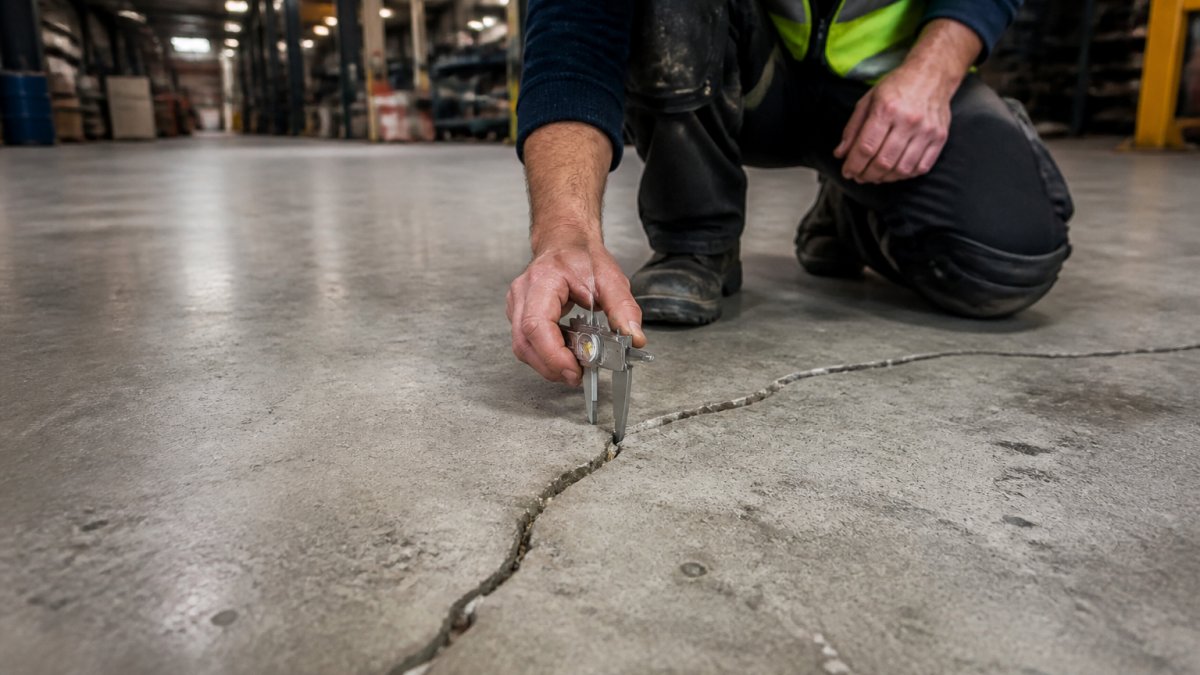
Measure crack width, depth, and movement first, and check whether edges are lifted or crumbling. A crack that changes width with temperature is a live crack, and rigid fillers will fail in it.
Filling a moving crack with a rigid epoxy is a common mistake. The crack often opens again within months and takes the surrounding coating with it.
Step 2: Choose the Right Concrete Floor Crack Filler or Sealant
Match the product to the crack, not the shelf. For a static crack needing load transfer, epoxy injection is standard; for a moving crack, flexible polyurethane sealant is better.
Main options: epoxy injection (static cracks), flexible polyurethane sealant (live cracks), concrete patching compound (wide or spalled areas), repair mortar (edges and worn sections), and levelling compound (uneven surfaces before coating).
For concrete floor crack repair before epoxy coating, the filler must be compatible with the coating system, silicone-based sealant stops epoxy from bonding.
Ask your supplier for the product’s movement capability rating. A sealant rated for 25% movement handles cracks that open and close far better than a general-purpose filler.
Step 3: Prepare the Crack Surface
Preparation decides whether the repair lasts. Clean the crack of dust, oil, and loose material with a wire brush, grinder, or vacuum to full depth.
Widen the crack into a V or square shape if the sealant needs a bonding shoulder.
For more detail on surface prep and coating compatibility, see CSIRO’s guide to concrete repair and protection.
Check the concrete is dry before filling. Moisture stops epoxy and most sealants from bonding properly. If the slab sits on a damp subgrade, address that first. Once the repair has cured, sealing the slab with a dedicated concrete sealing product helps limit moisture ingress that can reopen cracks over time.
A repair is only as good as its preparation. Skip the cleaning step and even premium materials will fail.
Frequently Asked Questions
How do you repair cracks in an industrial concrete floor?
Repairing cracks in an industrial concrete floor starts with assessing the crack width, depth and whether it is moving. Non-structural cracks can be filled with a concrete floor crack filler or flexible polyurethane sealant. Structural cracks often need epoxy injection to restore load transfer. Always clean the crack, remove loose debris and prepare the surface before applying any filler or sealant, then allow it to cure fully before resuming floor traffic.
What is the best product to fill cracks in a garage or warehouse floor?
The best concrete floor crack filler depends on the crack. For stable, non-moving cracks, a rigid epoxy resin or repair mortar works well because it bonds strongly and supports heavy loads. For cracks that move with temperature changes, a flexible polyurethane sealant is better because it stretches without tearing. In warehouses with forklift traffic, epoxy injection is often chosen for structural cracks, while flexible sealant suits expansion joints and active cracks.
Can you repair cracked concrete before applying an epoxy floor?
Yes, but the crack must be repaired properly first. Concrete floor crack repair before epoxy coating is essential, because epoxy is thin and will not bridge a moving or wide crack. Fill stable cracks with epoxy resin or repair mortar, and use a flexible sealant for moving cracks. Allow the repair to cure fully, then grind or level the surface so the epoxy coating adheres evenly and does not crack again under traffic.
Cracked industrial floors rarely stay a cosmetic problem. If the cause is subgrade settlement or ongoing movement, patching alone won’t hold. Apex Custom Coatings brings over 15 years of experience to concrete sealing, textured resurfacing, and epoxy coatings built for heavy traffic and harsh conditions. Contact us today to assess your floor and get a repair plan that lasts.